

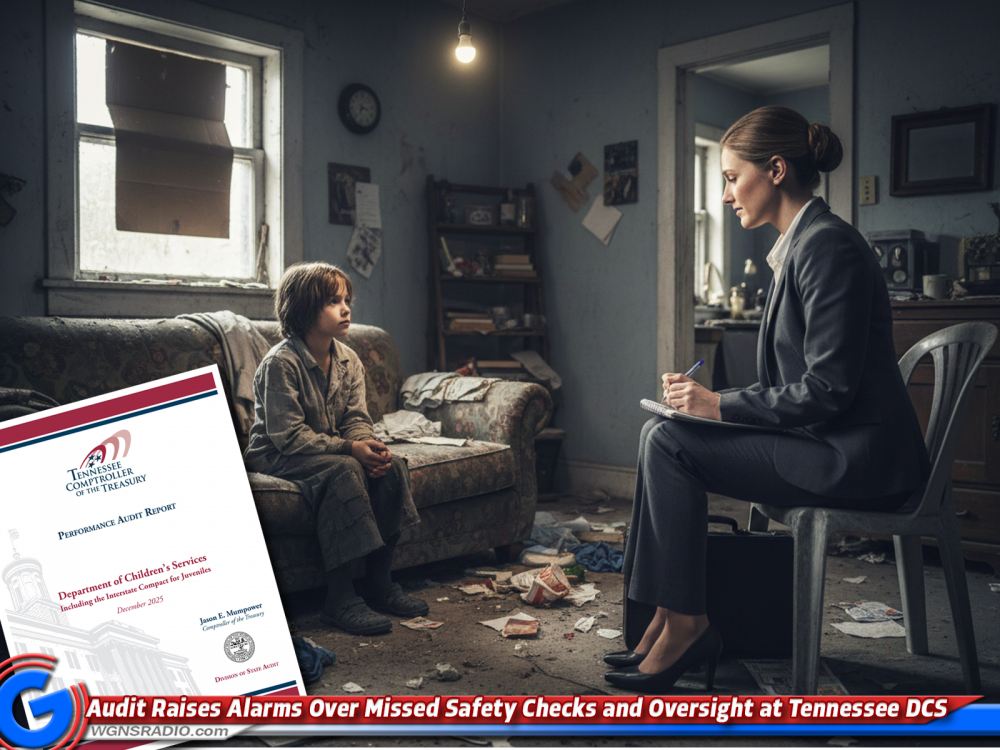
NASHVILLE, Tenn. — A newly released performance audit from the Tennessee Comptroller’s Office has raised concerns about oversight and compliance within the Tennessee Department of Children’s Services (DCS), citing missed safety checks, supervisory gaps, and low substantiation rates in child abuse investigations. The audit reviewed DCS operations from Sept. 1, 2022, through Sept. 30, 2025, and was issued in December 2025.
Although the audit does not break findings down by county or city, its conclusions apply statewide, including to Rutherford County and surrounding Middle Tennessee communities, which operate under the same DCS framework. Auditors emphasized that weaknesses identified at the state level directly affect how child welfare services are delivered locally.
One of the most concerning findings involved the Special Investigations Unit (SIU), which handles cases involving serious injury or death of a child and allegations against adults in authority roles. In a random sample of 65 SIU cases reviewed by the Comptroller’s Office, only four allegations were substantiated — a substantiation rate of about six percent. By comparison, the report notes that a national benchmark referenced by DCS leadership is approximately 20.9 percent.
In Tennessee, when DCS “substantiates” a case, it means investigators determined it is more likely than not that abuse or neglect occurred. A substantiated finding can carry serious consequences for parents or caregivers, including restrictions on working or volunteering in positions that involve children. Before a case is substantiated, investigators are required to follow a formal review process that includes documentation, supervisory approval, and the opportunity for due process and appeals.

The audit also found that required monthly face-to-face safety visits with children were missed in roughly one-quarter of SIU cases reviewed. In addition, nearly four in ten cases lacked required monthly supervisory administrative reviews — a key safeguard intended to ensure investigations are progressing properly and risks to children are being addressed.
Statewide workload data included in the audit highlights the scale of DCS responsibilities. Auditors cited thousands of investigations and assessments conducted during the review period, while noting that the total number of open DCS cases declined by approximately 11 percent between early 2022 and mid-2025. Auditors cautioned, however, that lower caseload numbers do not eliminate the need for consistent oversight, documentation, and compliance.
The report also documents a major internal restructuring at DCS in March 2025, when the department reduced its regional footprint from 12 regions to six. While the reorganization was intended to standardize operations and better balance workloads, auditors stressed that improved policies must be paired with consistent execution to ensure child safety across all Tennessee counties. See the Comptroller Report HERE.
Key additional findings from the Tennessee Comptroller’s audit:
- Investigations repeatedly missed required deadlines: Auditors found ongoing failures to meet statutory and policy timelines for child abuse and neglect investigations, increasing the risk that children could remain in unsafe situations longer than allowed under state law.
- Supervisory oversight gaps remained widespread: In many cases, required monthly supervisory reviews were either delayed, incomplete, or missing entirely, limiting management’s ability to catch investigative errors early and ensure child safety.
- Child fatality and near-fatality reporting delays: Prolonged investigations, delayed supervisory reviews, and the absence of a dedicated physician reviewer hindered the department’s ability to timely update public information about child fatalities and near-fatalities.
- Children left in temporary or transitional housing too long: Despite some improvements, the department has not fully met its oversight responsibilities for “hard-to-place” children who remain in transitional housing or temporary settings for extended periods.
- Outdated case-tracking system remains a risk: Auditors concluded the department cannot continue to rely on its existing Tennessee Family and Child Tracking System (TFACTS) without constant oversight, warning that past technology failures have already affected critical child-welfare operations.
- Delays in medical and dental care for children in custody: Children in state care continued to experience delays in required medical and dental screenings, raising concerns about unmet health needs and delayed treatment.
- Improper caregiver stipend payments identified: Weak oversight of eligibility determinations led to some stipend payments that did not comply with program requirements, prompting recommendations for stronger internal controls.
- Concerns at juvenile detention and residential facilities: The audit found the department must strengthen oversight of facilities housing custodial youth to ensure safety, compliance with standards, and accountability.
- Staffing pressures persist despite some progress: Although vacancy and turnover rates have improved since 2023, auditors noted the lack of clear benchmarks makes it harder to identify emerging staffing shortages before they impact caseloads and service quality.
- Child Abuse Hotline improvements noted—but incomplete: Call wait times and abandonment rates improved after peaking in 2024, but auditors said additional work is needed to strengthen screening tools and monitoring of online reports.
- Legislative issues flagged for consideration: The Comptroller suggested lawmakers consider expanding or clarifying statutory authority over juvenile detention centers and strengthening oversight rules for the Interstate Compact for Juveniles to improve transparency and accountability.
What the report is — and what it is not: The documents released by the Tennessee Comptroller of the Treasury are part of a comprehensive performance audit of the Department of Children’s Services, including the Interstate Compact for Juveniles. The audit is not organized by county or municipality and does not provide Rutherford County–specific statistics or direct county-to-county comparisons. Instead, it focuses on statewide oversight, internal controls, compliance practices, and operational processes that affect every county where DCS operates.
- See the Comptroller Report HERE.