

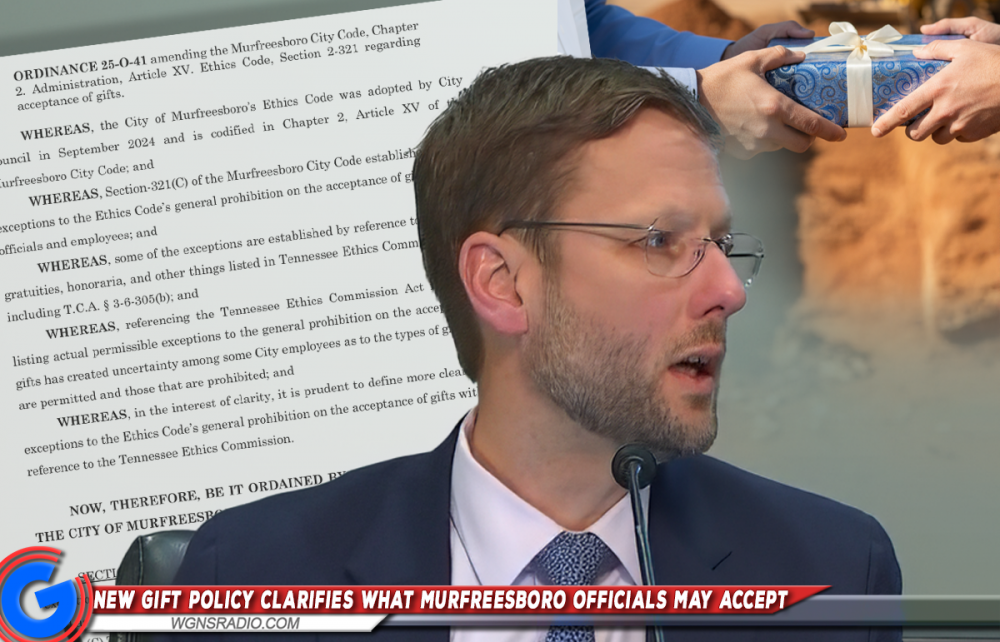
MURFREESBORO, Tenn. — The Murfreesboro City Council has approved changes to the city’s Ethics Code aimed at clarifying what gifts city employees and officials are allowed to accept, following months of uncertainty over how state ethics law applied at the local level. City of Murfreesboro Attorney Adam Tucker made the recommendation to city council members...
The ordinance, approved on first reading during the December 4 City Council meeting, amends Section 2-321 of the Murfreesboro City Code regarding the acceptance of gifts, gratuities, and honoraria. City officials said the change was necessary after the city adopted a new Ethics Code in September 2024 that referenced the Tennessee Ethics Commission Act rather than clearly listing which gifts were permissible. According to city staff, that language created confusion among some city employees over what was allowed and what was prohibited.
Under the updated ordinance, several categories of gifts are now clearly defined as acceptable, including non-cash gifts valued at $50 or less, informational materials such as books or recordings, promotional items routinely given to customers, unsolicited awards for public service, and certain meals or entertainment tied directly to work-related events. The ordinance also allows gifts from the City itself and gifts of minimal value shared equally among office staff. Gifts motivated by close personal friendships may still be accepted, but any such gift valued over $50 must be reported to the City Recorder within 14 days.

The ordinance also strengthens accountability by requiring that any gift accepted in violation of the Ethics Code must still be disclosed, and the disclosure does not prevent disciplinary action. Violations may still lead to sanctions, discipline, or other corrective measures as determined by the City.
During the meeting, council members voted in favor of the ordinance change... Council documents note that the clarification is meant to improve public trust in government while establishing a stronger and more transparent city brand. The ordinance will take full effect 15 days after passage on its second and final reading, which will be heard at the next council meeting.
More Details About the Change:
What Gifts Murfreesboro City Officials and Employees May Accept - Under the updated Murfreesboro Ethics Code, city officials and employees remain generally prohibited from accepting gifts, but the ordinance now clearly spells out specific exceptions. Among the allowed gifts are non-cash items valued at $50 or less, such as small tokens or appreciation gifts, as long as there is no intent to influence city business. Informational materials — including books, periodicals, printed materials, audio or video recordings, and similar educational content — are also permitted.
The ordinance further allows promotional or sample merchandise routinely provided in the normal course of business, such as items given to customers or suppliers. Officials may also accept unsolicited awards for public service, such as plaques, trophies, certificates, and honorary degrees, provided they cannot be easily converted into cash. Certain meals, refreshments, entertainment, and beverages tied to work-related meetings, conferences, or professional events are also permitted, as long as the total value does not exceed $50 per occasion per employee.
Additional approved exceptions include gifts shared equally among all members of an office, gifts from the City itself, and gifts given in connection with city-sponsored programs or events. Gifts motivated by close personal relationships — such as from family or longtime friends — may also be accepted, but any gift over $50 must be reported to the City Recorder within 14 days, including details about the giver, value, and circumstances.
The ordinance also strengthens transparency by making it clear that any gift accepted in violation of the Ethics Code must still be disclosed, and disclosure does not prevent disciplinary action. City officials may still face sanctions, discipline, or other corrective measures for violations. The goal of the clarified rules, according to council documents, is to remove uncertainty for employees while improving public trust in city government.