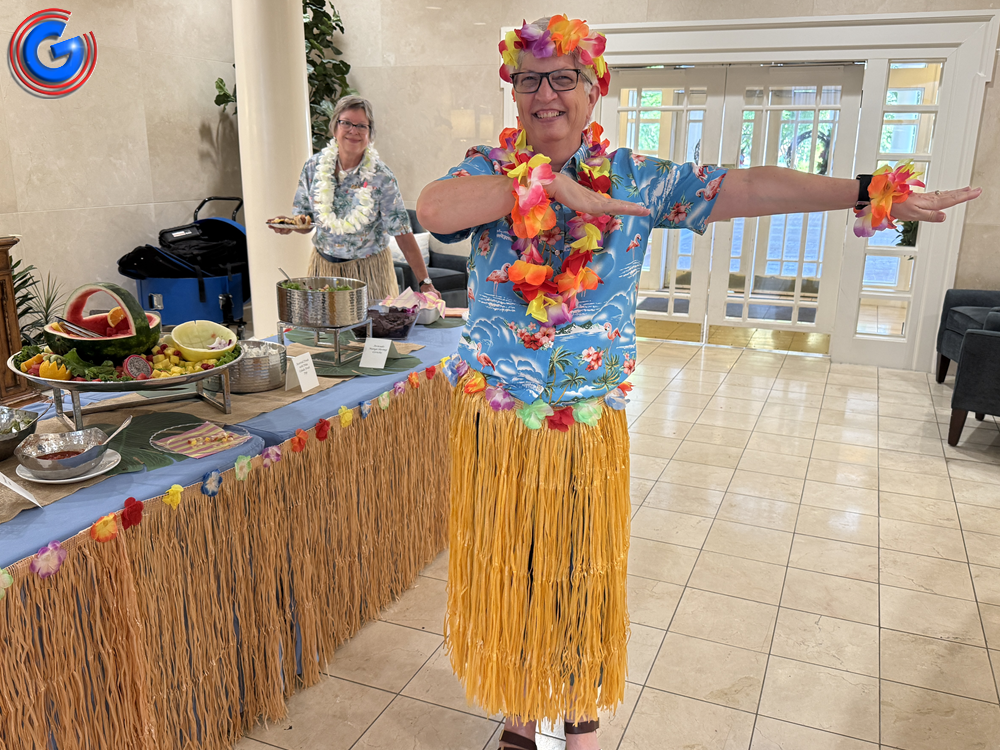
(above photo: AdamsPlace Executive Director Terri Deal offers social interaction and fun with a luau)

MURFREESBORO, TN (WGNS) - Just look around you. We live in a world of extremes. And no, this isn’t about politics—although that certainly proves the point daily. The extremes worth noticing are quieter, steadier, and far more hopeful. They’re found in the way we grow older, in the changing attitudes of seniors, and in a new group researchers are now calling “super agers.” These are the people who defy expectations, maintain sharp minds well into their 80s and 90s, and remind us that aging is not a decline—it’s a stage of life with enormous potential.
Middle Tennessee has been fortunate to have leaders who saw that potential long before the rest of the country caught on. Murfreesboro, Rutherford County, and neighboring Cannon County were shaped by one of those visionaries: Dr. Carl E. Adams, a homegrown physician whose ideas transformed how communities care for older adults.
The Birth of Modern Local Healthcare
In 1949, Dr. Adams and Dr. S. G. Garrison combined their independent practices to create Murfreesboro Medical Clinic (MMC), the region’s first multi‑specialty medical group. Instead of sending patients across scattered offices and towns, MMC brought primary care, specialty medicine, lab services, and radiology under one roof—a revolutionary concept for rural Tennessee. Today, MMC operates eight locations with around 100 physicians, 80 Advanced Practice Providers, and a staff of roughly 800, with a ninth location already in development.
Dr. Adams’ roots in Bradyville shaped his understanding of rural needs. He grew up surrounded by families who lacked access to coordinated care, and he carried those lessons into every project he touched.
A Vision for Aging with Dignity After Helping Establish MMC
Dr. Adams turned his attention to senior living. He believed older adults deserved more than basic housing—they deserved a campus-style environment that encouraged movement, thinking, social connection, and purpose. That idea became the foundation for National HealthCare Corporation (NHC), founded in July 1971 by Dr. Adams and supported by his wife, Jennie Mae, who shared his commitment to dignity in aging.
NHC began as a small network of skilled nursing centers. Today, it has grown into a major senior-care system operating across multiple states. The company now includes more than 10,000 skilled nursing beds, 26 assisted living communities, nine independent living communities, 34 home care agencies, 30 hospice agencies, and three behavioral health hospitals.
AdamsPlace in Murfreesboro stands as a direct reflection of Dr. Adams’ “campus concept,” offering multiple levels of care in one connected community.
The Rise of the “Super Agers”
While Dr. Adams was building environments that support healthy aging, researchers were discovering that some age 80+ adults maintain the cognitive abilities of people decades younger. These “super-agers” show memory performance similar to individuals in their 50s or 60s.
Vanderbilt University Medical Center has played a key role in studying this group. Their research shows super-agers are 68% less likely to carry the APOE‑ε4 gene—the strongest genetic risk factor for late-onset Alzheimer’s—and nearly 30% more likely to carry the protective APOE‑ε2 variant. They also tend to grow more new neurons in the hypothalamus, the brain’s memory center, than their peers.
Can a “Closet Super-Ager” Be Unlocked?

Yes— genetics are only part of the story. That’s where places like AdamsPlace come in. Plus, super-aging is defined by cognitive strength, not physical mobility. A person using a walker or wheelchair can absolutely be a super-ager. What matters most is the environment.
Research shows enriched surroundings, social engagement, mental challenges, physical activity, and supportive design—can stimulate neurogenesis even in our 80s and 90s. Senior living communities reduce isolation, introduce new learning opportunities, and remove physical barriers that drain energy. When older adults no longer have to fight through daily obstacles, they can redirect their focus toward creativity, connection, and curiosity.
In other words, the right environment can reveal a super-ager who has been there all along.
Aging in the Right Place at the Right Time
Have you ever considered that you or your senior loved ones—may be living in exactly the right place to age not only with dignity, but with ability? Middle Tennessee’s senior-care landscape was shaped by a local physician who believed aging should be a season of growth, not decline. Today, science is proving Dr. Carl E. Adams, Sr. right.
WGNS will continue this series on super-agers and explore how our community is becoming a catalyst for research, resilience, and a new understanding of what it means to grow older.